
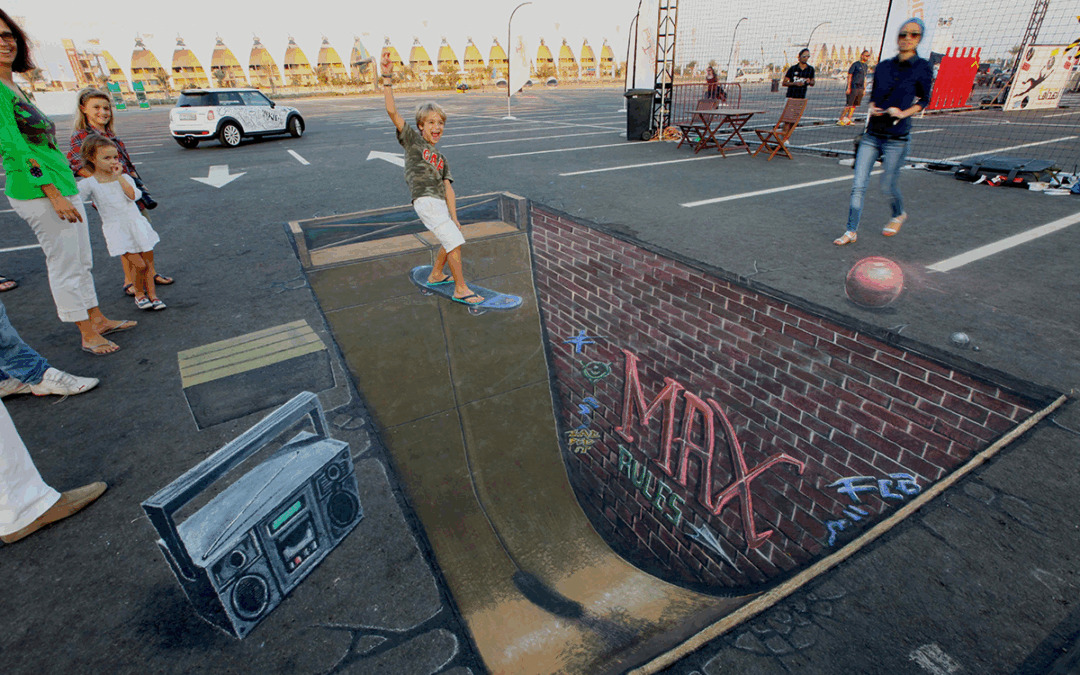
Walking through downtown San Francisco last week, I stopped dead in my tracks. There, projected onto the side of a building, was a massive 3D holographic whale swimming through the air. Passersby pulled out their phones, kids pointed in wonder, and for a moment, the boundary between digital and physical reality completely dissolved. This is what 3D art looks like in the Bay Area—bold, innovative, and absolutely everywhere.
Why 3D Artists Are Flocking to the Bay Area
The connection between our region and 3D art isn’t coincidental. With tech giants like Pixar calling Emeryville home and gaming companies scattered throughout the Peninsula, the Bay Area has become the unofficial capital of digital creativity. But it’s not just about the big studios anymore. Independent 3D artists are carving out their own space, creating everything from virtual reality experiences to massive sculptural installations that blend physical and digital elements.
What makes this particularly exciting is how Bay Area 3D artists are pushing beyond traditional boundaries. They’re not just creating assets for movies or games—they’re developing interactive installations for museums, designing augmented reality experiences for public spaces, and even collaborating with biotech companies to visualize complex scientific concepts.
The Local 3D Art Scene You Need to Know About
San Francisco’s Gray Area Foundation has emerged as a crucial hub for experimental 3D art. Their annual showcase features artists who use cutting-edge technology to create immersive experiences that would be impossible anywhere else. I recently attended their exhibition featuring VR sculptures that you could walk through and manipulate with your hands—it felt like stepping into a science fiction movie.
Over in Oakland, the tech scene is more grassroots but equally innovative. Artists are setting up studios in converted warehouses, collaborating with local makerspaces, and creating large-scale 3D printed sculptures that comment on everything from housing inequality to environmental change. The monthly First Friday events regularly feature 3D projection mapping that transforms ordinary buildings into dynamic canvases.
Pixar’s influence extends far beyond their Emeryville campus. Many former employees have launched independent studios throughout the Bay Area, bringing film-quality 3D artistry to everything from architectural visualization to medical training simulations. This cross-pollination between commercial and fine art has created a unique ecosystem where technical excellence meets creative experimentation.
3D Art in the Age of AI and VR
The Bay Area’s 3D artists are grappling with questions that feel particularly relevant in 2025. As AI tools make 3D creation more accessible, artists here are exploring what it means to be human in an increasingly digital world. I’ve seen installations that respond to viewers’ emotions, sculptures that evolve based on real-time data, and virtual worlds that exist only in shared AR experiences.
Take the work of local artist collective Hyphen Labs, whose VR installations tackle social justice issues through immersive 3D environments. Their piece “NeuroSpeculative AfroFeminism” created virtual spaces where users could experience alternative realities and challenge their assumptions about identity and technology. It’s the kind of work that could only emerge from a place where artistic vision meets technological capability.
The Tools and Techniques Shaping Local Work
Bay Area 3D artists have access to resources that would make creators anywhere else envious. The proximity to tech companies means early access to new software, hardware, and techniques. Many artists are experimenting with real-time ray tracing, volumetric capture, and AI-assisted modeling tools that are still experimental elsewhere.
But it’s not just about having the latest technology. The collaborative spirit here means artists regularly share techniques, resources, and even studio space. Makerspaces like Noisebridge in San Francisco and The Crucible in Oakland have become gathering places where 3D artists can access professional-grade 3D printers, laser cutters, and motion capture equipment.
Breaking Into the Bay Area 3D Art World
If you’re interested in 3D art, the Bay Area offers numerous entry points. The California College of the Arts in Oakland has developed a renowned digital media program, while Academy of Art University in San Francisco focuses on commercial applications. But don’t overlook the informal networks—meetups, online communities, and collaborative projects often provide the most direct path into the scene.
For those just starting out, consider visiting the Exploratorium’s After Dark events, which regularly feature interactive 3D installations. The San Jose Museum of Art has also been expanding their digital art programming, offering workshops and exhibitions that make 3D art accessible to broader audiences.
The Future is Already Here
What strikes me most about Bay Area 3D artists is their willingness to experiment with emerging technologies while staying grounded in human experience. They’re not creating art for art’s sake—they’re using 3D tools to address real problems, tell important stories, and create connections between people.
As we move further into 2025, the line between physical and digital art continues to blur. Bay Area 3D artists are at the forefront of this transformation, creating experiences that couldn’t exist anywhere else. Whether it’s AR sculptures that respond to climate data, VR installations that explore social issues, or massive projection mapping that transforms entire neighborhoods, they’re proving that 3D art is far more than just pretty pictures on a screen.
The next time you’re walking through the Mission, SOMA, or downtown Oakland, keep your eyes open. You might just encounter a piece of 3D art that changes how you see the world—or at least makes you stop and wonder what’s possible when creativity meets technology.
Interested in exploring more 3D art in the Bay Area? Follow our artist spotlights and gallery guides for the latest exhibitions and installations. Are you a 3D artist working in the region? We’d love to feature your work—reach out in the comments below.